
Tennis Elbow & Golfer's Elbow · Meridian, ID
Tennis elbow and golfer's elbow have little to do with tennis or golf. They are tendon injuries that stay stuck because the tendon gets limited blood flow and the forearm above it stays tight. Fix both, and the elbow can finally heal.
Book a Treatment
Most chronic elbow tendon pain isn't a simple inflammation that rest and anti-inflammatories can clear. It's a worn, stressed tendon with limited blood supply, attached to a forearm muscle that's tight and bound up. That's why a cortisone shot can work for a few weeks and then the pain comes right back.

Same type of injury, opposite sides of the elbow. We treat both the same way: the tendon, the forearm, and whatever is feeding the problem.

Pain on the outer bump of the elbow that can run down the top of the forearm. Worst when gripping, lifting with the palm down, twisting, typing, using a mouse, or swinging a racket or paddle. Common in pickleball, painters, mechanics, and desk workers.

Pain on the inner bump of the elbow that can run down the inside of the forearm. Worst when gripping, carrying, lifting palm up, swinging, throwing, or hammering. Common in golfers, lifters, builders, and anyone who grips all day.
The Super-Pulsed Laser Difference
A tendon that's been hurting for months isn't just inflamed. It's stalled. Rest doesn't restart it, a brace doesn't restart it, and a steroid shot can quiet the pain without helping the tendon rebuild.
The super-pulsed laser delivers deep light energy straight into the tendon attachment at the elbow. It wakes up the cells that repair tendon, drives blood flow into tissue that normally gets very little, and calms the irritation that keeps the area sore.

If your elbow has been stubborn for months, we look past the tendon and check what's loading it and what's mimicking it.
Knotted forearm muscles pull on the tendon every time you grip. Adhesion Release Method frees them so the tendon stops being overloaded.
A nerve stuck in the forearm or at the elbow can cause pain that looks just like tennis or golfer's elbow, and no amount of tendon treatment will fix it.
Irritated nerves and tight tissue in the neck and shoulder can refer pain down the arm and into the elbow.
Scar tissue from a past elbow, wrist, or shoulder injury can change how the arm moves and keep the tendon under strain.
Braces and straps offload the tendon while you wear them. They don't change the tendon or the tight forearm pulling on it.
Cortisone shots can quiet pain for a few weeks, but they don't rebuild tendon, and the pain often returns once they wear off.
Rest helps a fresh strain. A tendon that's been hurting for months needs a reason to repair, and that takes more than time off.
Our approach combines super-pulsed laser for the tendon, acupuncture to calm the pain and relax the forearm, and Adhesion Release Method to free the muscles and nerves around it. We treat the elbow and what's loading it.

Patient Story
She came in as a dental assistant with 15 years in the chair, and she wasn't sure she'd be able to work again. Her elbow hurt that badly. She was getting shooting pains down her arm, and every shift made it worse.
When I palpated her elbow and forearm, the tissue was packed with adhesions. They were entrapping both the median nerve and the radial nerve. That explained the shooting pain. Resting it and strapping it was never going to free a nerve that's stuck in scar tissue.
We treated the adhesions directly with Adhesion Release Method and acupuncture. After about four treatments, the change was dramatic. At her last visit she told me she was 95% out of pain.

She wrote this review a few days later:
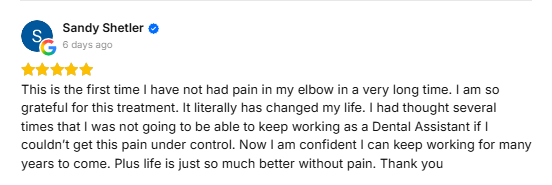
Individual results vary. This is one patient's experience.
They're the same kind of tendon problem on opposite sides of the elbow. Tennis elbow is on the outside; golfer's elbow is on the inside.
No. Pickleball, tools, typing, lifting, and repetitive gripping are far more common causes.
It depends on how long you've had it and what's driving it. After your first visit we'll give you a plan.
No. Most people feel little or mild warmth.
Usually yes, with some adjustments we'll go over with you.
Get an exam, a clear answer on what's driving the pain, and a plan to get your grip back.
Book a Treatment